Friday, August 9, 2013, Last day in Yellowstone.
I was going to update yesterday's post first, but today was pretty interesting so I'll do it first. But if the internet connection holds up, I'll go back and update yesterday's entry. (I'm assuming someone is actually reading this.)
Yellowstone was the first national park in the world, so it's our oldest and I think one of our biggest. The road system is a large figure 8 with 5 roads leading away from the 8 to outside the park. We're staying at a cabin a Canyon Village, which is about at the middle of the 8. Yesterday we did the southern loop, which included Old Faithful, so today was the day for the nothern loop. You can see maps and things at www.nps.gov/yell.
Steve had a nice chat with a ranger when we first entered the park and we've been following his suggestions. So today we headed toward Roosevelt Lodge, stopping to look at Washburn Hot Springs.
This hot spring area is so unstable that they have given up trying to make it accessible. This is as close as you can get. They warn you about this all the time, but today Steve saw two people step off the path to touch the water. Twelve people have lost their lives doing that and hundreds have been seriously injured over the years.
Yellowstone is continually battling forest fires, some worse than others. In 1988, 36% of the park burned. I've tried to enhance the photo below to show what a burned out hillside looks like.
The far hillside is gray with tree skeletons. Closer at hand, you see a green forest fading to gray. The
gray is what burned. As you travel through Yellowstone, lots of mountainsides have two or three shades of trees. The young ones are lighter green and shorter and they may be growing next to a taller tree area that has even taller trees beyond it. The youngest trees are growing on the most recently burned areas. Throughout the shorter trees you see the skeletons of burned trees standing. My guess is that most of Yellowstone has burned at one time or another in the last 50 years.
We continue on to Roosevelt Lodge and go through some roadbuilding, which focuses us on some unique geology.
This undulating stone is not from the contruction work, as I spot the same seam across the canyon.
We reach Roosevelt Lodge, which is very rustic and small, (but does have real bathrooms) and, taking our ranger's advice, take the road leading out of the park through the Lamar Valley. We're only supposed to take it for about 10 miles and then come back and finish the northern loop. But it should be good for spotting wild life.
The way you spot wildlife in Yellowstone is to watch for people pulled over. We saw a couple of cars pulled over that were watching something we couldn't see with the naked eye, but then, at the top of a rise in a wooded patch, a man had set up a telescope focused on an osprey nest. And there were chicks, which aren't so small by this time. Here's the nest:
We traveled on, seeing a single bison or two, and then there's a small herd. And then there is an entire valley filled with bison. We have so many buffalo pictures it's hard to pick just a few. There are way more buffalo than yesterday.
After seeing hundreds of buffalo spread across this valley, we turn around to continue on the northern loop. All along the way, we see people flyfishing and some hiking. There seem to be hundreds of hikes in this park. Back on the northern loop, we are headed for Mammoth Hot Springs, one of the places the ranger said to see. It's also a small town with the park headquarters and as it turns out, is packed. Did I say Yellowstone was a bit crowded? And we've missed high tourist season of July.
Before we hit Mammoth Hot Springs, we stop to see a petrified tree. It turns out to be interesting. It's just a stump, 6 foot tall or so, but it's genetically identical to California Redwoods and was petrified in an erruption 50 million years ago. It's taking too long to load photos to include one here. I'm sure there's one on the web if you google it. We also stop and take a picture of Undine Falls before entering Mammoth Hot Springs. Here is the hot spring it's named after.
That whole mountain side is covered with hot springs. The mineral deposits expand the mountain at the rate of about 3 feet a year. They keep having to move the trails to the viewing areas. It is indeed Mammoth.
It looks like I'm having trouble uploading photos today, too. They will be added as soon as we have better connections.
We take a loop road to look at the top of Mammoth Hot Springs and get some interesting shots.
This area is outside of the volcano caldera, so the activity is surprising but things keep changing. Once off the loop road we drive up into a high valley and spot some brown birds we're not familiar with. They look like herons, but are not blue. I'll get a picture up when I can.
There is a side road to something called the Virginia Cascade that we decide to take. I'm guessing we're going to see a series of small waterfalls and we do. I'll add a picture when I can.
But the surprise lies ahead.
There is a bison walking down the road toward us. Calmly, like he owns the place, (he does), he heads for us. Steve is taking pictures with his camera out the window. We are stopped. He contiues to walk toward us and walks right by, about 3 feet from Steve, who does not try and touch him. We have had a buffalo encounter! I hope this picture loads!
Well that's enough excitement for the day. We contiune back to Canyon Lodge and our cabin, stopping to pick up a salad and a sandwich for dinner. Pulling up to our cabin, I notice people beside it with their cameras out. We have deer in our back yard!
A great end to a great day!
Now if I could just get more pictures posted!
I managed a few, but it's like pulling teeth, so I'm off for now. We should be back in civilizaion tomorrow, so maybe we'll have more luck.
Friday, August 9, 2013
Thursday, August 8, 2013
Thursday, August 8, 2013 Yellowstone National Park.
Wednesday we moved from Grand Teton National Park to Yellowstone National Park. Although these parks are next door to each other, they are totally different. Grand Teton is a flat valley bordered by these immense craggy mountains on one side and Yellowstone is an active volcano. Yes, I said active. All the geothermal activity shown by the geysers, mud pots, vents and pools is part of a volcano. The park is really a large caldera (volcano bowl). Yellowstone is also mostly covered in lodge pole pines.
It's really amazing. This morning we started at the south rim of the Grand Canyon of Yellowstone. Assuming Steve gets the camera to cooperate, I'll add pictures. My computer has decided it doesn't like the chip from Steve's camera. Here's our current computer set up. Steve has his phone hanging from the light fixture and a cable to my computer. We're hooked up through AT&T
Wednesday we moved from Grand Teton National Park to Yellowstone National Park. Although these parks are next door to each other, they are totally different. Grand Teton is a flat valley bordered by these immense craggy mountains on one side and Yellowstone is an active volcano. Yes, I said active. All the geothermal activity shown by the geysers, mud pots, vents and pools is part of a volcano. The park is really a large caldera (volcano bowl). Yellowstone is also mostly covered in lodge pole pines.
It's really amazing. This morning we started at the south rim of the Grand Canyon of Yellowstone. Assuming Steve gets the camera to cooperate, I'll add pictures. My computer has decided it doesn't like the chip from Steve's camera. Here's our current computer set up. Steve has his phone hanging from the light fixture and a cable to my computer. We're hooked up through AT&T
The south rim of the canyon has Artist Point, which is a view back up the canyon to a water fall. You may have seen it in anything that references Yellowstone. I'll add a picture when I can.
We keep running into silver Prius and once again found ourselves parked by one.
I've gotten used to looking for a silver prius instead of a blue one. I wonder how long it will take me to switch back?
Loading photos is taking forever tonight, so I'll try to get a few up but not many.
Since Yellowstone is an active volcano, this area experiences frequent earthquakes. The ranger Steve spoke to said the earthquakes "change the underground plumbing" and things that were active become still and vice versa. One of the geysers recently erupted after 8 years and they have no idea when it might erupt again. Which is why Old Faithful is so amazing. It erupts every 40 - 100 minutes. We got to see it right after lunch.
We saw a few elk today, but today belonged to the bison (or buffalo). Traffic was stopped on the road and there was a small meadow with 5 or 6 bison, so Steve got out and took a few pictures. But it was obvious there was a greater attraction just over the hill. So I got behind the wheel to move up as we inched forward and Steve headed for the top of the hill on the other side of the road where 6 or 8 people were. Whatever he saw absorbed his whole attention and he did not notice that one of the bison was also climbing the hill. I can't yell, he can't hear me, chances are good the cell phones won't work, but luckily one of the other people there realized he didn't know what was going on and
got his attention.
got his attention.
He did get a good shot of that bison. What was capturing his attention on the other side of the hill was an entire valley of bison. We saw two more valleys of bison and a few close ups of some trying to cross the road. I'll come back and add photos when it won't take all night.
Well, we're having connection issues, so I'll sign off. More later
Tuesday, August 6, 2013
Tuesday, August 6, 2013 Float trip
We are up at the lodge by 8:45 am and they pile us on a bus at 9. We drive over to the Snake River 10 minutes away. Here's our float raft.
There will be 20 guests and two river guides on the trip and we end with lunch by the river.
This will be our scenery for the entire trip. We see beaver dams.
And blue heron.
And two eagles.
One mule deer.
Also canadian geese and chipmunks, but I won't include pictures. There are two different groups horseback riding along the river. It would be a beautiful place for that.
After two and a half hours of floating, we reach our lunch destination. And this is my view while I eat.
Tomorrow we head for Yellowstone. It's directly north of here, but will take close to three hours to drive to the lodge we are staying in. Time to get organized and packed up.
We are up at the lodge by 8:45 am and they pile us on a bus at 9. We drive over to the Snake River 10 minutes away. Here's our float raft.
There will be 20 guests and two river guides on the trip and we end with lunch by the river.
This will be our scenery for the entire trip. We see beaver dams.
And blue heron.
And two eagles.
One mule deer.
Also canadian geese and chipmunks, but I won't include pictures. There are two different groups horseback riding along the river. It would be a beautiful place for that.
After two and a half hours of floating, we reach our lunch destination. And this is my view while I eat.
Tomorrow we head for Yellowstone. It's directly north of here, but will take close to three hours to drive to the lodge we are staying in. Time to get organized and packed up.
Monday, August 5, 2013
Reasons for having an RV: no packing and unpacking, our own pillows, better lighting, nightstands on either side of the bed, a refrigerator for leftovers and breakfasts, and we'll each have our own desk.
Steve is hogging the tiny table and I'm blogging typing on a pile of pillows.
I'm reaching back to Saturday to get all our exploits in. Steve went on two additional adventures on Saturday. He visited EBR1 - Experimental Breeder Reactor 1. It was the first electricity generating power plant and was decommissioned in 1964. It's part of the Idaho National Laboratory. Wikipedia has a nice page on it.
After that, he headed back to Craters of the Moon to take a 3 hour evening hike, starting at 7 pm. He was hoping to take pictures of stars, but the hike ended before it was really dark enough. He did get a picture of a night blooming flower.
Reasons for having an RV: no packing and unpacking, our own pillows, better lighting, nightstands on either side of the bed, a refrigerator for leftovers and breakfasts, and we'll each have our own desk.
Steve is hogging the tiny table and I'm blogging typing on a pile of pillows.
I'm reaching back to Saturday to get all our exploits in. Steve went on two additional adventures on Saturday. He visited EBR1 - Experimental Breeder Reactor 1. It was the first electricity generating power plant and was decommissioned in 1964. It's part of the Idaho National Laboratory. Wikipedia has a nice page on it.
After that, he headed back to Craters of the Moon to take a 3 hour evening hike, starting at 7 pm. He was hoping to take pictures of stars, but the hike ended before it was really dark enough. He did get a picture of a night blooming flower.
On a two and a half week trip, you either pack a lot of luggage or you do laundry. We usually choose laundry. So Sunday was a designated laundry day. We had checked on line and there was a laudromat in Arco, Idaho. We even drove by and checked their hours - 8 am to 8 pm 7 days a week. Good to go. So bright and early Sunday we have breakfast, load up the car and head for the laudromat. We go in and Steve notes there is no detergent or change available. He heads for the gas station/convenience store next door and I load up washers.
Time for plan B. No detergent available. Unload the washers, pack up the car, and head for Idaho Falls. Steve decides we should stop at the first grocery store we see in Idaho Falls and pick up detergent and a few extra items we need. He pulls in at an Albertson's and parks in front of the laundromat next door. Bingo! He gets the laundry out while I run into Albertson's.
The washers are tiny. We have three loads. The instructions want you to put powder detergent in one container at the beginning of a cycle or liquid in a different spot after the first rinse. I bought pods good for a single load. No place to put them. Steve decides he'll watch the loads and put the pods in appropriately. There are signs around telling us not to use extra detergent as the water is soft. Can you see where this is going? Yup, had to send each load through an entire second cycle to get all the soap out.
Once we get everything in the dryer, Steve has me check on restaurants for lunch. Urban Spoon (iPhone app) says there's a good mexican place at the end of the strip mall. Yeah. Only it's closed on Sunday. We pass another restaurant closed on Sunday and I'm beginning to worry. But the next recommendation from Urban Spoon, Smitty's, is open and doing a good business. We have a good lunch. By the way, in this part of the country, one of the sides available is tater tots, as in "Do you want chips, fries, or tots with that?"
Then it's on to Grand Teton National Park in Wyoming. I swear the scenery changes by state. California was fertile fields followed by pine forested mountains. When the pine forests changed to desert, we were in Nevada. When irrigated farming started (and casinos stopped) we were in Idaho. For the last bit of Idaho, irrigation wasn't required, but they were looking hard for flat spaces to farm. When we ran out of farmland and were back in pine forested mountains, we had entered Wyoming.
I've heard of Jackson Hole, usually in terms of skiing. Turns out hole is a term for valley, so this is the Jackson Valley, one side of which is the Grand Tetons. There is a town called Jackson and a Jackson Hole ski resort. Both of which seem very touristy. Jeremy, Marilyn and John, this area reminds me of New Zealand. Even part of the Snake River here looks like the braided rivers there. And Jackson reminds me of Queensland. Too many tourists, too many shops. The antler arches are different, though.
We saw a number of these. But this is what we came for:
a bear and her cub
Monday morning, Steve is awake early (5 am-ish) and heads out to take sunrise pictures. Blessedly he lets me sleep.
He manages to catch the sunrise and some mule deer.
And this bird. He got the name of it from a park ranger later, but he's now asleep, so I'll pass that information along later. But it's a neat photo.
I'm awake by the time Steve returns. He has plans to hike at Jenny Lake today. Sounds doable. We walk up to the Lodge for breakfast; we're staying in a "cabin" - motel like unit. The walk up to the lodge and back tires me out and I realize that my cold needs more sleep. I urge Steve to go hiking and am almost asleep bfore the door closes. I really did need the sleep; I sleep all day.
Steve has a great day and take lots of pictures. Unfortunately, some of them don't want to transfer to my computer. But here's some of what he saw:
Jackson Lake
Jenny Lake
The chapel was built before the land became National Park Land. The park was established in the early 1920's consisting of only the actual mountains. When John D. Rockefeller, Jr. visited around 1926, he realized that more area needed to be preserved and started buying up land. He tried for 20 years to get the government to accept the land as a gift. In the meantime, he built lodges and other items needed and established the company that runs the lodges today. In the 50's, the government finally accepted all this land into the national park.
Tomorrow we're going to try a float trip!
Saturday, August 3, 2013
Saturday, August 3, 2013 Craters of the Moon National Monument
I wake up to a gentle shaking this morning. "It's 7:30. There's a cave walk at 9:00 I'd like to take. Can we please? Huh? Please?" Groan. Anyone who knows me knows I'm grumpy in the morning, especially when you wake me up. I pull myself out of bed and start getting ready. "You have to wear closed toe shoes." OK. "Where's your water bottle? We have to take water bottles." Dirty look. Steve finds my water bottle without help. "Did you pack a flashlight?" No, I packed a water bottle, Steve packed a flashlight. Almost ready. "Grab a breakfast bar to eat on the way. Then we'll be on time." Not my favorite way to start the day. I need to work on teaching Steve what vacation and retirement mean.
But it was a good idea. The weather was cool and the skies were blue. A walk through a lava field shows the variations in the lava. Although it all looks black at a distance, it seems to come in all colors of the rainbow.
I wake up to a gentle shaking this morning. "It's 7:30. There's a cave walk at 9:00 I'd like to take. Can we please? Huh? Please?" Groan. Anyone who knows me knows I'm grumpy in the morning, especially when you wake me up. I pull myself out of bed and start getting ready. "You have to wear closed toe shoes." OK. "Where's your water bottle? We have to take water bottles." Dirty look. Steve finds my water bottle without help. "Did you pack a flashlight?" No, I packed a water bottle, Steve packed a flashlight. Almost ready. "Grab a breakfast bar to eat on the way. Then we'll be on time." Not my favorite way to start the day. I need to work on teaching Steve what vacation and retirement mean.
But it was a good idea. The weather was cool and the skies were blue. A walk through a lava field shows the variations in the lava. Although it all looks black at a distance, it seems to come in all colors of the rainbow.
And there are all different textures. This one reminds me of trying to frost a cake.
There are smooth boulder shapes and rough spiky rocks. These look like rising dinner rolls.
Note the tiny evergreen in the middle of the picture. This lava flow is 2000 years old and plants are just beginning to sprout in pockets where dust has collected.
The goal of the walk is to visit a lava cave. These are formed as the lava flows downhill. The outside of the flow cools, forming a shell that the hot lava flows through. When the hot lava stops, the hollow shell remains. At some point, part of the shell collapses, creating an opening to the cave.
This was the first cave we came to.
According to the map, it goes in quite a long ways. I guess I'm not into spelunking. I'm not crawling on volcanic rock to get into a cave. The cave that was the goal of the walk was Indian cave. This cave was actually used by indigenous people ages ago for shelter. I ran out of steam before we reached the cave and stop to rest and turn back.
The rest group moves on and I experience the silence. I have never not heard anything. As I head back to the parking lot, at times I can even see the highway that borders the park, but hear no traffic. Apparently the volcanic rock absorbs sounds. An insect buzzes me for about 15 seconds and if I turn my head just right I can hear the wind against my ear. Pretty amazing.
There is a 52 mile system of fissures along which these volcanoes erupted between 15,000 and 2,000 years ago. Eruptions occurred roughly every 2000 years, so we're overdue.
Steve's out taking a night time walk, hoping to get some good pictures of stars. We forget how beautiful the stars are when there's no light pollution. If he gets any good pictures, I'll post them tomorrow.
Friday, August 2, 2013
I stopped yesterday's blog entry without talking about dinner. We ate at the Star Hotel, which is a Basque (an area of Spain) restaurant. The Basques helped settle this area. If you are any where close to Elko, Nevada, you shouldn't miss this restaurant.
Steve ordered one of the specials, the bacon wrapped fillet, for $18, while I had the salmon for $20. Then they brought out the bread, soup and salad, all served family style. We tried to pace ourselves, because we knew there were side dishes coming, but we weren't ready when they started bringing the food. Here's what our table looked like:
We could have gotten 3 servings at least out of each of our entrees. And since we're on the road, there's no point in doggie bags. I might have to break down and get a cooler.
Friday morning we headed for the local museum, the Northeastern Nevada Museum. Part of the reason we came through Elko was that one of Steve's distant relatives donated a wing to this museum. He was a big game hunter and wanted to give his trophies to a museum so that others could enjoy them.
I hadn't given this much thought when Steve mentioned it , so I wasn't really prepared to see taxidermied endangered species. We're assuming they weren't endangered when he hunted them.
One thing I found neat was the Pony Express cabin they had out front. I had not known that the company had cabins for the riders. I assumed they stopped at stage coach stops.
After the museum, we hopped in the car and headed for Arco, Idaho, the closest town to Craters of the Moon National park. We stop in Wells, Nevada for lunch at Bella's Espresso House, recommended on Trip Advisor. Good recommendation. The small towns of Nevada seem to consist of casinos, hotels and restaurants. There was even a casino at the truck stop.
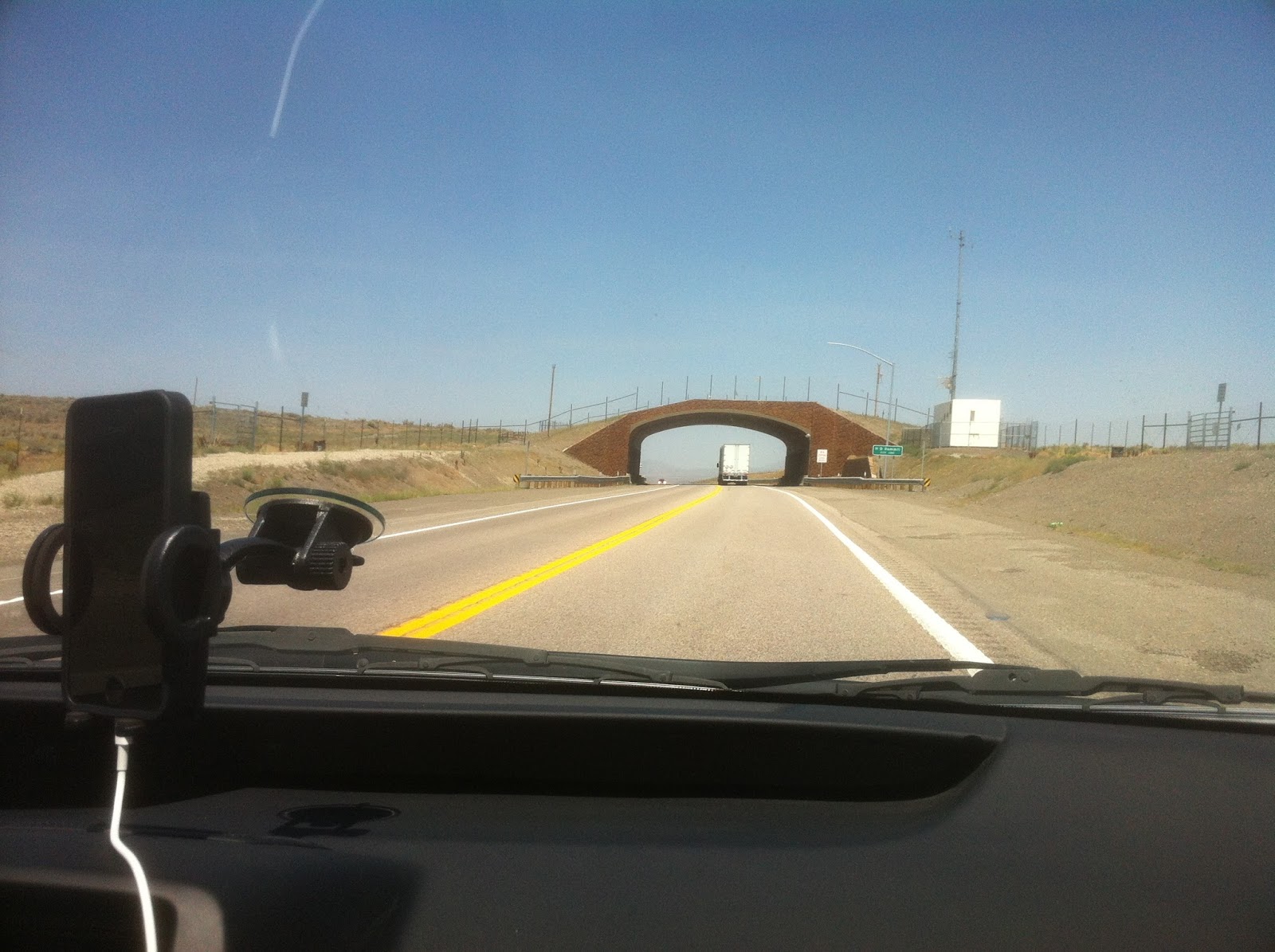
At this point, we leave I-80 and head north on US 93. The scenery changes to more rolling hills. We're in an open range area and there are bridges for the cattle to cross the road.
As we near the border with Idaho, the valley floors seem to be a little greener but there are still only trees around buildings. And you can no longer tell where streams are by a row of trees. The last Nevada town seems to be less than a mile from Idaho and has hotels, casinos, and restaurants. And I'm not sure it's as big as Mulberry. Oh, and RV parks. They get a lot of traffic from Idaho, where gambling is illegal.
As we cross over into Idaho, the scenery shifts a bit. Its greener, especially around towns and the valley floors aren't flat, but gently rolling. I see actual cowboys! There are maybe 50 cows in a fenced area and four guys on horses surrounding a pickup truck. We stop at the Salmon Falls Creek rest stop and take a picture and then stop at a historical marker a few miles away.
I stopped yesterday's blog entry without talking about dinner. We ate at the Star Hotel, which is a Basque (an area of Spain) restaurant. The Basques helped settle this area. If you are any where close to Elko, Nevada, you shouldn't miss this restaurant.
Steve ordered one of the specials, the bacon wrapped fillet, for $18, while I had the salmon for $20. Then they brought out the bread, soup and salad, all served family style. We tried to pace ourselves, because we knew there were side dishes coming, but we weren't ready when they started bringing the food. Here's what our table looked like:
My salmon is in front, with green beans, red beans and white beans, the Basque bread, french fries, spaghetti and at the other end, Steve's fillet. And everything was delicious!
We could have gotten 3 servings at least out of each of our entrees. And since we're on the road, there's no point in doggie bags. I might have to break down and get a cooler.
Friday morning we headed for the local museum, the Northeastern Nevada Museum. Part of the reason we came through Elko was that one of Steve's distant relatives donated a wing to this museum. He was a big game hunter and wanted to give his trophies to a museum so that others could enjoy them.
I hadn't given this much thought when Steve mentioned it , so I wasn't really prepared to see taxidermied endangered species. We're assuming they weren't endangered when he hunted them.
One thing I found neat was the Pony Express cabin they had out front. I had not known that the company had cabins for the riders. I assumed they stopped at stage coach stops.
After the museum, we hopped in the car and headed for Arco, Idaho, the closest town to Craters of the Moon National park. We stop in Wells, Nevada for lunch at Bella's Espresso House, recommended on Trip Advisor. Good recommendation. The small towns of Nevada seem to consist of casinos, hotels and restaurants. There was even a casino at the truck stop.
At this point, we leave I-80 and head north on US 93. The scenery changes to more rolling hills. We're in an open range area and there are bridges for the cattle to cross the road.
As we near the border with Idaho, the valley floors seem to be a little greener but there are still only trees around buildings. And you can no longer tell where streams are by a row of trees. The last Nevada town seems to be less than a mile from Idaho and has hotels, casinos, and restaurants. And I'm not sure it's as big as Mulberry. Oh, and RV parks. They get a lot of traffic from Idaho, where gambling is illegal.
As we cross over into Idaho, the scenery shifts a bit. Its greener, especially around towns and the valley floors aren't flat, but gently rolling. I see actual cowboys! There are maybe 50 cows in a fenced area and four guys on horses surrounding a pickup truck. We stop at the Salmon Falls Creek rest stop and take a picture and then stop at a historical marker a few miles away.
For those who don't want to strain their eyes, a dam was built across the creek in 1910 to create a reservoir for irrigation. Someone miscalculated - the reservoir didn't fill up until 1984! But irrigation is the key difference between this area and the Nevada we passed through. There are farms here, but anything that isn't irrigated is brown. And we still have mountains to look at.
We make it to Arco, Idaho, and get ready to tour Craters of the Moon National Park tomorrow.
Thursday, August 1, 2013
Reno sits in a desert valley, surrounded by light brown hills. We start the day by looking for gas and breakfast. I suggest Bob Evans, Cracker Barrel or McDonald's, as I know what I can eat there. Steve checks Urban Spoon and google and laughingly tells me the nearest Bob Evans is in Missouri and there are no Cracker Barrels in Nevada. But Urban Spoon (iPhone app) leads us to a local restaurant named Jacks which serves up a decent breakfast.
We stop for gas before hitting I-80 east again and encounter something we've never seen before - a cash or ATM only gas station. So we fill up. We could probably make it to our next stop without filling up, but we know it is sometimes 150 miles or more between gas stations.
We pass from one desert valley to the next. But unlike Indiana valleys, the valley floor is flat and goes for miles. They look much the same at first glance, but each seems to have it's own character.
One valley looks like it might have salt flats, like they used to land the space shuttle on when it couldn't land in Florida. Lots of flat white areas. Near the shoulder area of the road, people have used dark rocks to spell out messages - their name or initials or Deb heart Steve.
Another valley has small patches of dark rock that seem to be almost uniform in size. Fist sized dark brown rocks creating a scarred look.
And for most of the day we follow the railroad and, it turns out, the California Trail that the wagon trains used. There are historical markers at the rest stops and an interpretive center that we didn't stop at. Here's a sign you won't see at a Midwest rest stop:
Reno sits in a desert valley, surrounded by light brown hills. We start the day by looking for gas and breakfast. I suggest Bob Evans, Cracker Barrel or McDonald's, as I know what I can eat there. Steve checks Urban Spoon and google and laughingly tells me the nearest Bob Evans is in Missouri and there are no Cracker Barrels in Nevada. But Urban Spoon (iPhone app) leads us to a local restaurant named Jacks which serves up a decent breakfast.
We stop for gas before hitting I-80 east again and encounter something we've never seen before - a cash or ATM only gas station. So we fill up. We could probably make it to our next stop without filling up, but we know it is sometimes 150 miles or more between gas stations.
We pass from one desert valley to the next. But unlike Indiana valleys, the valley floor is flat and goes for miles. They look much the same at first glance, but each seems to have it's own character.
One valley looks like it might have salt flats, like they used to land the space shuttle on when it couldn't land in Florida. Lots of flat white areas. Near the shoulder area of the road, people have used dark rocks to spell out messages - their name or initials or Deb heart Steve.
Another valley has small patches of dark rock that seem to be almost uniform in size. Fist sized dark brown rocks creating a scarred look.
And for most of the day we follow the railroad and, it turns out, the California Trail that the wagon trains used. There are historical markers at the rest stops and an interpretive center that we didn't stop at. Here's a sign you won't see at a Midwest rest stop:
This is open range country and the rest stops and freeway entrances have cattle gates to keep out the cows. We only see a few cows scattered throughout, except for a herd of about 20 who were huddled together in the shade of a billboard. It's only in the 80's today, but there are few trees. If you see a row of green across the valley, it's probably a stream with trees and other vegetation along it's banks.
We keep seeing small clouds of dust near the ground and assume they are cars on a dirt road or a farmer in the field. But at least some of them are small dust storms. We see one ahead and I try for a picture:
It's hard to see, but in the middle of the picture is a cloud rising from the road. That's really a small dust storm - wind kicking up the dust. I'm sure there is a more technical name for it.
I'm writing this on Friday morning and Steve is anxious to get going. He wanted to be at the museum at 9 am and we're going to be a bit late. So I'll log off for now and tell you about Thursday's dinner later.
Subscribe to:
Posts (Atom)