Sunday, July 26, 2015

Sunday, July 26, 2015

We are at Hay Lake, Fort Liard, Northwest Territories.  This seems to be a popular local park with 12 campsites and no hook ups.  That means we are supplying our own electricity and water and we’ll have to dump our tanks at our next stop.  We’re using our propane for cooking and heating. It’s been a nice relaxing camp.

I didn’t expect to have Internet access, but thanks to all the mining companies around here, there is cell service so we have Internet. 

Here’s the view out my side window:


And the view out the back window.


 There’s a trail around the lake and apparently they don’t want people snowmobiling on it.

We are in the Northwest Territories of Canada and we mostly came up here to add another territory to our list.  It sounded like it would be a nice trip and was, except for the rain, but the scenery hasn’t been spectacular.  The sign welcoming us to the Northwest Territory:


 The bridge Steve said reminded him of one of the rides at Disney World:


But when we got to the campground and got settled in, the wildlife started making an appearance.  First (as always) came the ducks.


More ducks.


Then the swans from the end of the lake came close enough for some pictures.
But we couldn’t get all 5 in the same shot.


Non aquatic birds also made an appearance.  We think this might be a gyrfalcon.
And these birds played along the shore.
But we really got excited about the beaver, who was fetching twigs for his dam.


Neither picture is wonderful, but we had fun watching him.


We headed back to Fort Nelson tomorrow.  Then it’s on to Dawson Creek, where the Alaska Highway (formerly known as the Al-Can highway) officially starts/ends.  Luckily there are still highways beyond that to take us to Jasper and Banff.


Deb

Friday, July 24, 2015

Friday, July 24, 2015

We are in Fort Nelson, British Columbia, Canada.


It was an overcast, rainy day today, coupled with road construction.  I took a few scenic pictures.

Our last look at Muncho Lake:


A braided river
.

And then we saw the moose.  He was maybe 100 yards off the side of the road, content to pose for pictures for awhile.


We’ll probably be off the grid for the next two nights.  We’re headed up to Fort Liard in the Northwest Territory.  It’s supposed to be a beautiful spot.


Deb
Thursday, July 23, 2015

We are at Northern Rockies Lodge on the Alaska Highway between Watson Lake and Fort Nelson.  It’s in British Columbia.  And this is the view out my window:


The side window has a view of the float plane the owners use for flight seeing trips. 


The day in Watson Lake started off with a rainbow.


The scenery was beautiful.


But the stars today were the bison.  First we saw one.


Then two:


And then we found the herd:


Mommas and babies


Six babies in this picture, two laying together poking each other.  Kids will be kids.


And this guy walking up beside us to make sure we weren’t going to cause any trouble.


We saw one more bison, but he was heading into the woods.  But then we saw the black bear!


He posed nicely and was still munching along the side of the road when we moved on.


There was some heavy construction today, but no major delays.  It looks like they are upgrading and straightening out one of the older sections of the highway.  Steve read that they didn’t want a straight highway when it was built, as that would make it easier for the Japanese to shoot up a supply convoy, if war ever came to this land.

The Northern Rockies Lodge is an interesting place.  It’s on its third owners, who bought it as place to base their flight seeing operations.  They fly people up to a remote National Park or to one of their remote cabins for sightseeing and fishing expeditions.  They built a new lodge a number of years ago when their business outgrew the original lodge and now have rooms in the lodge, cabins, most on the lake, and spaces for RVs to park.  And a good restaurant.


A great stop in a beautiful location!  We hope to be back!


Deb
Wednesday, July 22, 2015

Wednesday, July 22, 2015

We are near Watson Lake, Yukon Territory, Canada.  I hope to get this posted today, as we will probably be out of Internet or phone range for several days, although we may have service tomorrow.

Cottonwood Campground is on the shore of Kluane Lake and we enjoyed the beauty here.  The morning we left, a float plane landed.  We think it was scheduled to take some of our neighbors on a sight seeing flight.

We left Cottonwood Campground on July 18 and headed for Whitehorse, Yukon Territory.   The wind was down and not blowing glacier dust down the valley, so we could get a good picture of the lake and mountains from our campsite.

We stopped at the Tachal Dhal Visitor Center for Kluane National Park (Canadian), hoping to see sheep on Sheep Mountain.  But they weren’t visible that morning, so we continued on.

The scenery is beautiful, so we enjoyed the drive.  One guidebook we rely on is called Milepost and I believe they have just about everything along the highways in this part of Canada and Alaska documented.  It suggested we stop at Sulphur Lake, which is supposed to be stopping place for migrating birds and have lots of eagles’ nests around the lake.

It’s a pretty lake, but we only saw one bird.  It was an eagle, but too far away to get a decent picture.  But we enjoyed the view.  I even took an “artsy” picture of it:


The road to Sulfur Lake was single lane and a mixture of gravel and soft sand, which dead-ended at the lake.  With a lot of luck and four-wheel drive, Steve managed to get the trailer turned around and got us back up the hill to the Alaska Highway.

We stopped for lunch at Haines Junction and visited the Kluane National Park headquarters.  The building houses the National Park headquarters, the local visitor center and the First Nations heritage center.  In fact, that seems to be the governing model for most of the area.  The First Nation people have subsistence rights over most of the land, including hunting in national park areas, but also have responsibility to help maintain the land and wildlife.  As an example, there is currently a ban on fishing certain types of salmon in the Dawson Creek area to allow the fish to repopulate.  The First Nation people agree and help administer the ban. 

All along the way, we encounter bicyclists, mostly solos, some pairs and some groups.  This is such rugged country, I’m not sure bicycling solo is a smart thing to do.  But some of the groups are on really long trips.  Note the sign on this bike we spotted at lunch.

Our next stop was Canyon Creek Bridge, which is an old bridge being restored next to the newer one that is used for the highway traffic.  

This area has been a trail for the First Nation people for generations before the Al-Can highway was built.  Originally, wood bison (otherwise known as buffalo) roamed this area and are now being reintroduced.  We didn’t manage to see any in the wild.

It was on to Whitehorse and time to catch up on some chores.  Steve did laundry and got the oil changed on the truck.  He also visited the Copperbelt Railroad and Mining Museum, where he got to ride on a mine train.

Much of the economy of the Yukon and British Columbia rests on mining as well as tourism.  They still mine a lot of gold here, as well as other minerals and jade.

Monday we took in the Yukon Wildlife Refuge outside of Whitehorse.  It was nice to see some of the animals up close that we had only seen in the distance.  And even nicer to see animals that we would never get to see otherwise.

The Arctic Ground Squirrels seemed to think my toes were food and headed straight for me until I screeched and moved.  They weren’t expecting food to move and veered away.  But since this happened at several of our bus stops around the refuge, I don’t think I was imagining things.

Elk are not native to Canada and were introduced during the building of the highway to provide more sources of meat.  They have not thrived very well.

The snowy owl is elusive, but posed politely for us.  She’s injured and can’t fly.

Mule deer have migrated north into Canada and seem to thrive.

This big horned sheep is taking a nap.  I’d have a neck ache!

The musk ox looks prehistoric.

The lynx is good at camouflage and Steve had a hard time getting a good picture.

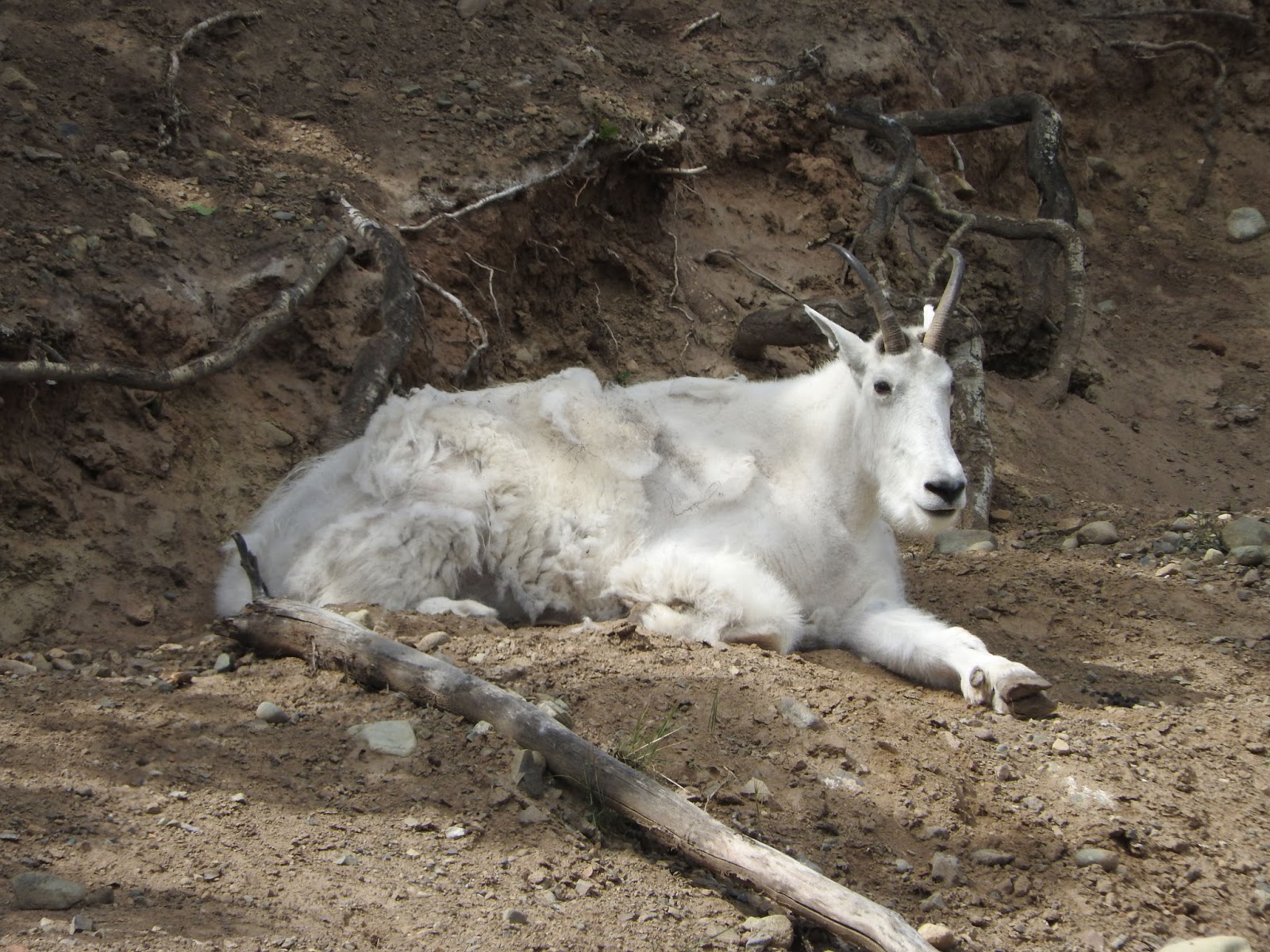
This mountain goat found a shady hillside.

The artic fox was also elusive.  This is his summer fur; his winter fur is white.

The pens for the large animals were appropriately large.  This was as close as we were going to get to a moose at the refuge.

The wood bison was last on the tour.  They were also in a large pen and keeping their distance.

The wood bison were thought to be extinct and then they found a small herd, I think in the Northwest Territory (of Canada), east of the Yukon Territory.  They’ve been breeding them and repopulating them to areas where they used to roam.

We left Whitehorse on Tuesday and drove to Teslin.  Here’s some of the beautiful scenery along the way.


Our campground in Teslin gave us a pretty good view.

And then one of the locals dropped by for a visit.

It was a great way to end the day.

Deb